
What is price-optimized battery charging
For end customers with a neoom KJUUBE/STAAK battery storage system, grid charging of the storage is fully automatically optimized based on dynamic EPEX Spot Day Ahead electricity prices. neoom Ai is designed to maximize cost efficiency and creates a so-called schedule with 15-minute intervals for battery behaviour.
neoom Ai schedule instructions can be:
- Recharge electricity cheaply from the grid
- Hold the battery charge and do not discharge energy from the battery
- Charge the battery with PV electricity
- Discharge the battery for self-consumption
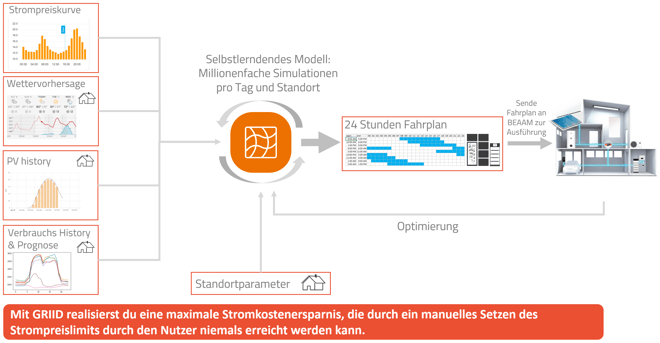
To achieve this, neoom uses a self-learning, AI-based model that also takes a wide range of cost-influencing parameters into account. In addition to the hourly electricity purchase price, the site-specific PV production forecast and consumption forecast, these parameters also include charging and discharging losses depending on the battery charge and discharge current. The model is self-learning and also checks how accurate the forecasts were in order to further optimize them in the future. The model applies per individual site and thus achieves the maximum electricity cost savings per end customer (site)
Overview of how the self-learning model works:
What added value does “Price-optimized charging of the battery from the grid at dynamic tariffs” offer the end customer?
Simulations with our self-learning model have shown that an end customer (household with 10,000 kWh annual consumption and a 10 kWh battery) can save around €130 per year in electricity costs with price-optimized charging of the battery from the grid. These simulations are based on an average neoom Ai site and depend, besides annual electricity consumption, battery size and PV system size, above all on electricity market fluctuations on the power exchange. (The greater the swings, the more neoom Ai can “harvest” through “BUY / HOLD of energy”, as on the financial exchange) The higher the annual electricity consumption, the greater the savings potential through price-optimized battery charging. neoom Ai always achieves a higher saving for the customer compared to manually setting the electricity price limit from which the battery should be charged from the grid.
The saving described here refers exclusively to price-optimized battery charging. For price-optimized charging of the electric car you can find more information here
neoom Ai continues to be expanded and in future will also be able to enable price-optimized control of consumers such as the heat pump or the electric hot water heating element. This further increases the annual savings potential.
How can the function be operated?
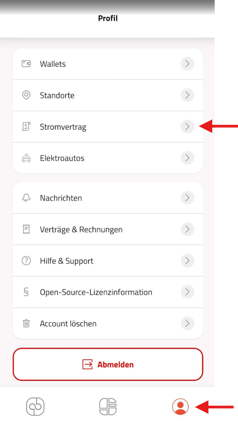
Step 1: Before you can use the functions of neoom Ai, you must enter your electricity tariff information via the neoom App:
Step 2:
The functions of neoom Ai are available exclusively with the Mega pricing plan. Make sure that you are a user of such a plan.
Step 3:
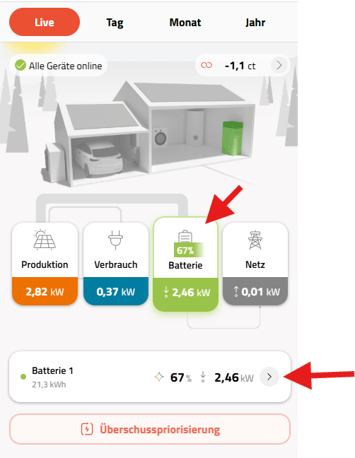
Via the dashboard, the user reaches the detail page of the battery.
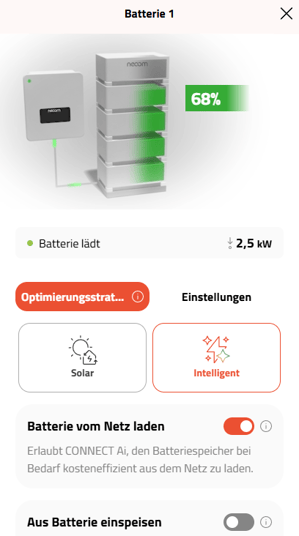
After tapping the arrow, the user gets an overview of the current status on the storage detail page, such as "Battery fully charged" ("Batterie voll geladen") or "Battery charging" ("Batterie lädt"), as well as the selection for the optimization strategy. Here the user can choose between "Solar" ("Solar") or "Intelligent" ("Intelligent") (based on neoom Ai) to charge their storage.
Dependencies:
Prerequisite for use:
The end customer needs:
- a KJUUBE/STAAK electricity storage system with Solax or Sofar inverter. BLOKK storage systems as well as third-party battery systems controlled by the BEAAM and neoom Ai are currently not yet supported.
- a BEAAM that is online
- energy management must be activated in neoom Ai (setting under connect.neoom.com -> Devices ("Geräte") -> Configure site ("Standort konfigurieren") -> Energy management ("Energiemanagement"))
- a correct site configuration (Easy to check: As soon as the PV surplus prioritization feature works, neoom Ai is also functionally possible at that site)
- for Germany: an Intelligent Metering System (IMSys) (Intelligentes Messsystem)
- for Austria: a Smart Meter
- a PV system
- a dynamic electricity tariff (a dynamic draw tariff is mandatory / for the feed-in tariff the customer can choose between dynamic or fixed)
- Mega or Giga pricing plan
Currently, only hourly or every-15-minutes varying dynamic tariffs based on the EPEX Spot Day Ahead power exchange are supported.
The function is also available in Switzerland. There, optimization can currently be based on peak/off-peak tariffs (Hoch/Nieder Tarife).
Which dynamic tariffs are currently not supported:
Special tariffs from certain electricity grid providers (so-called synthetic tariffs) that change daily, weekly or monthly.
Further current limitations:
- The site must have existed for >2 days so that the machine learning function has a minimum data set for a PV generation and consumption forecast for the site.
- Only for customers who have 1 KJUUBE/STAAK. MAIN / SUPPORT systems (cascaded systems) are supported!
- Currently unsupported hybrid inverters / storage systems: third-party storage / hybrid inverter systems (e.g.: Huawei Luna, Fronius & BYD)
- Not usable for customers with a manually set time and power limit for optimizing feed-in → this must be deactivated so that GRIID can optimize automatically
Using the feature at KLUUB (energy community) sites:
If you are part of an Austrian energy community and at the same time use a dynamic draw or feed-in tariff, you should note the following:
neoom Ai has no real-time information on whether electricity is currently being drawn from the energy community or from the grid. This is because the electricity grid operators do not provide the Smart Meter data for a site in real time, but these are available at the earliest on the following day.
neoom Ai can, however, forecast on the basis of historical data whether the electricity is currently being drawn from the grid or from the energy community and derives the actions on the basis of this forecast.