
How the electricity price is composed:
The electricity price is made up of several building blocks:
1. Energy price (Energiepreis): This is the price for the actual electricity you consume. It is set by the energy supplier and often depends on exchange prices and long-term contract models.
On your electricity bill this component is often labelled as follows: Energy price (Energiepreis), energy working price (Arbeitspreis Energie), procurement costs (Beschaffungskosten), energy supply (Energielieferung), electricity supply (Stromlieferung)
2. Grid charges (Netzentgelte): With these you pay for the use of the electricity grids. These costs are not set by your energy supplier, but by the grid operator. They arise because electricity must be transported through lines and the grid must be maintained. Grid charges (Netzentgelte) are grid-operator-specific and differ greatly by country and region.
On your electricity bill this component is often labelled as follows: Grid working price (Netzarbeitspreis), grid usage charge (Netznutzungsentgelt), grid charge energy (Netzentgelt Arbeit), transmission charge (Durchleitungsentgelt), grid usage energy (Netznutzung Arbeit)
Rough average values of grid charges (Netzentgelte) by country: Germany: ~ 12 cent/kWh Austria: ~ 9.3 cent/kWh Switzerland: ~ 13 cent/kWh
A list of all electricity grid operators in Austria can be found for example here: https://stromliste.at/verzeichnis
For Germany you will find in the neoom App under Profile ("Profil") -> Electricity contract ("Stromvertrag") -> When managing your electricity contract a list of all grid operators:

In Switzerland, unlike in the EU, there is no so-called "unbundling" between grid operator and energy supplier. That is why in Switzerland you largely also obtain your energy from your grid operator.
3. Statutory levies and surcharges (Gesetzliche Abgaben und Umlagen): These include state or regional levies and surcharges
Examples for Germany:
- §19 StromNEV (§19 surcharge (Umlage), StromNEV surcharge (Umlage StromNEV), industry privilege surcharge (Industrieprivileg Umlage))
- Offshore grid surcharge (Offshore Netz Umlage) (Offshore surcharge (Offshore Umlage), offshore grid costs (Offshore Netzkosten))
- CHP Act surcharge (KWKG Umlage) (combined heat and power surcharge (Kraft-Wärme-Kopplungs Umlage), CHP surcharge (KWK Umlage))
- AbLaV surcharge (ABLaV Umlage) (interruptible loads surcharge (Abschaltbare-Lasten Umlage), AbLa surcharge (AbLa-Umlage))
Examples for Austria:
- Electricity tax (Elektrizitätsabgabe)
- Usage levy energy (Gebrauchsabgabe Energie)
- Usage levy grid (Gebrauchsabgabe Netz)
- Renewable funding flat rate (Erneuerbare Förderpauschale)
Examples for Switzerland:
- Concession levy (Konzessionsabgabe)
- Funding levy (Förderabgabe)
- Levies to public authorities (Abgaben an Gemeinwesen)
They apply equally to all households.
In summary: Your electricity price therefore does not consist only of "the electricity itself", but to a large extent of infrastructure costs and state levies.
Which types of electricity contracts exist:
Contracts for drawing electricity from the grid:
Fixed tariffs: A constant price per kWh over the entire contract term. Stable and easy to plan.
Peak/off-peak tariffs (Hoch-/Niedertarife): Here the price differs by time of day. During the day (peak tariff (Hochtarif)) electricity is more expensive, at night (off-peak tariff (Niedertarif)) cheaper.
Monthly adjusted tariffs: The price changes once per month and is often oriented to market prices or grid costs.
Hourly adjusted tariffs (dynamic tariffs): These tariffs follow the hourly or 15-minute prices of the EPEX Spot electricity exchange directly.
Contracts for feeding into the grid:
If you have a PV system, you produce your own electricity. If more electricity is generated than you consume yourself, you feed the surplus into the public grid.
For this you usually receive a remuneration:
Fixed tariffs: You receive a fixed remuneration rate per kWh fed in, independent of the market price.
Monthly adjusted tariffs: The feed-in remuneration is adjusted once a month to current market conditions.
Hourly adjusted tariffs (dynamic tariffs): The remuneration follows the hourly EPEX Spot prices, ideal for systems with high production at strong market times.
Subsidized tariffs (ÖMAG in Austria and EEG in Germany): State-regulated feed-in remunerations.
Why it is important that the electricity contract data is entered correctly in the neoom App
From April 2026 you can enter your detailed electricity price data with all the price components described above and for the different contract types. This is important so that neoom Ai can optimally control your consumption on the basis of your electricity price data and your own production, and so that your savings and revenues are displayed correctly.
How I can enter the electricity contract data in the neoom App
In the Profile ("Profil") section of the app (icon at bottom right), tap "Electricity contract" ("Stromvertrag").
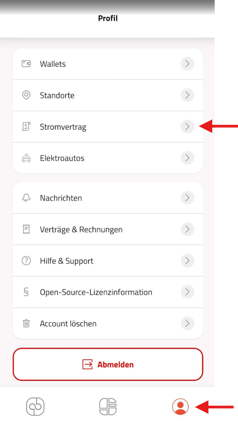
Entry of the tariff components is designed to be as self-explanatory as possible.
Because the electricity price components and tariff types differ by country, the app automatically provides different entry options for Germany, Austria and Switzerland, depending on the country in which your neoom Ai site is registered.
Possible electricity draw or electricity feed-in contract types by country:
Fixed price ("Fixer Preis"): Germany, Austria, Switzerland
Dynamic price ("Dynamischer Preis"): Germany, Austria
If you have a peak/off-peak electricity tariff (Hoch/Nieder Stromtarif), a monthly adjusting electricity tariff or a subsidized electricity tariff, please select "Fixed price" ("Fixer Preis")
If you have a peak/off-peak grid tariff (Hoch/Nieder Netztarif), you can select this for both a fixed and a dynamic electricity contract.
In Switzerland there are currently no EPEX Spot based dynamic tariffs for household customers. However, because more and more grid operators offer their own dynamic tariffs, we will also offer the option to configure a dynamic tariff for Switzerland in the course of 2026.
Currently in Switzerland you can choose whether you have a fixed or a so-called peak/off-peak tariff (Hoch/Nieder Tarif). If you have configured the latter, you can activate the optimization strategy "Intelligent" ("Intelligent") for charging the battery and the car from the grid at favourable tariffs. You can find details here: Intelligent battery charging Intelligent car charging
Related articles:
Frequently asked questions:
- Which items from my electricity bill do I need to take into account in the neoom App when managing the electricity tariff. Take into account all consumption-dependent components, i.e. those where the price is stated in cent/kWh.
- For Germany: I cannot find my grid operator in the selection list in the app The list includes all of Germany's more than 860 distribution grid operators (as of end of 2025). Please note the difference between energy supplier and grid operator on your electricity bill.
- Can neoom help me transfer the data from my electricity bill into the app Unfortunately we can no longer offer this for effort reasons. We have tried to design the entry interface in our app as simply as possible and to adapt it to the typical labels on the electricity bill in the respective country. Unfortunately electricity bills are often also very different regionally and not always easy to understand. (This topic is a known problem at the regulatory authorities in Germany and Austria, which will hopefully be resolved soon). If you have questions about how exactly to transfer the bill data into the neoom App, your installation partner for the neoom storage system can help you further.